Am I Eligible for an ADU in NYC? Check an interactive map here
Why build an ADU now?
Accessory Dwelling Units (ADUs), also known as "granny suites", and "in-law apartments", were legalized in NYC as part of the City of Yes legislation giving New Yorkers more freedom with their properties. ADUs can be a good a good fit for home owners who:
-
Want more space for family & friends Adding 1-2 bedrooms can make space for adult children to live, a guest apartment for family & friends, or maybe space for older relatives to live later in life in order to receive care while.
-
Looking for a source of rental income & property value increase A code-compliant ADU can generate steady income and increase resale value. In many cases, an ADU can be financed and the mortgage covered with rental income, while also raising the overall value of the home. Only a subset of NYC lots qualify for ADUs, and they only recently became legal. Having one of the relatively rare properties with a permitted ADU can make your home especially appealing to future buyers.
What are the main types of ADUs?
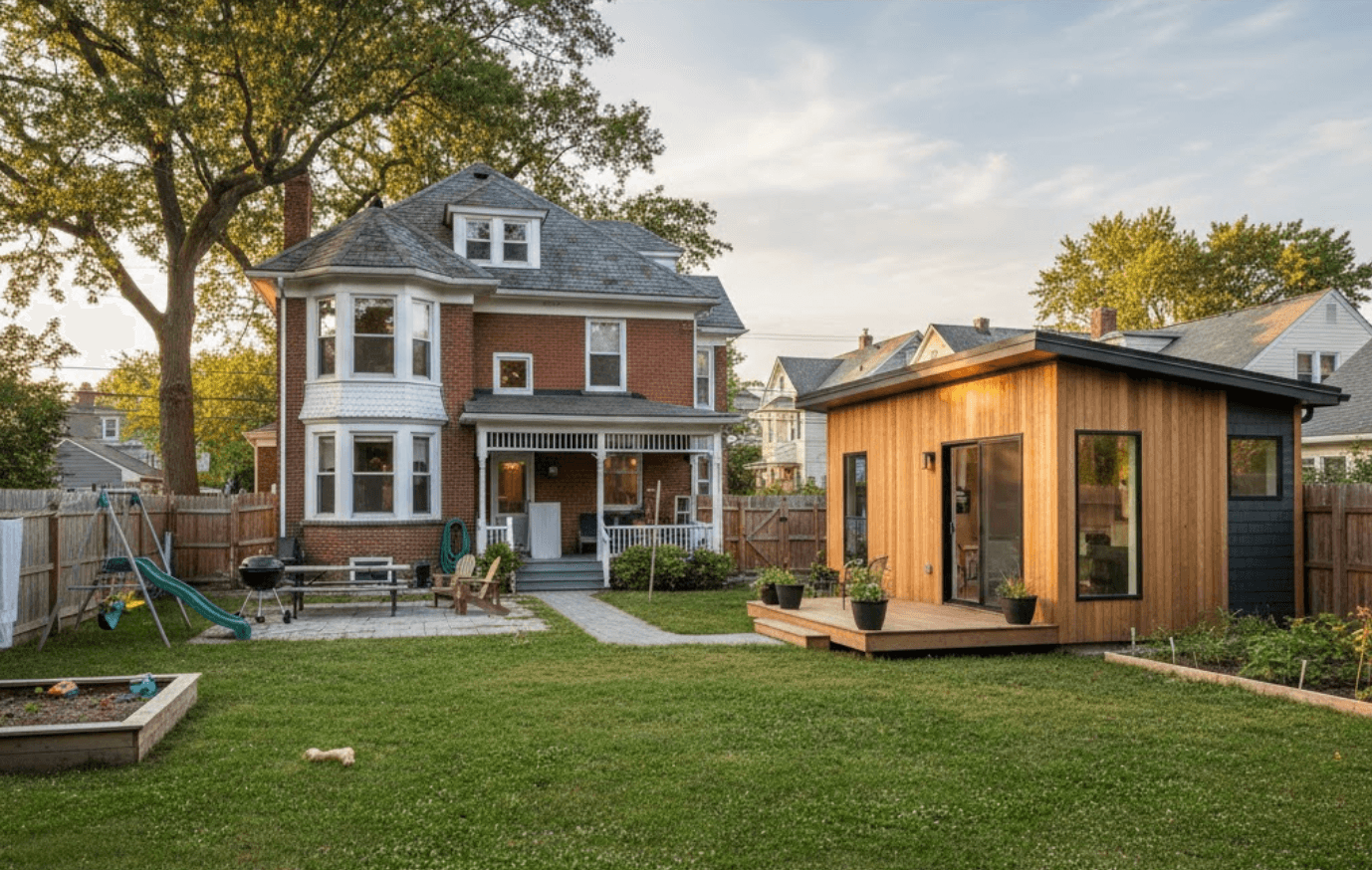
- Backyard detached ADU - the typical "in-law apartment" ADU pictured above where there is a second separate building in the backyard
- Backyard attached ADU - a second living space attached to the back or side of the main house
- Basement ADU - a basement with a separate entrance, kitchen, and bathroom from the main house
- Garage ADU - a garage converted into a living space
- Attic/ Loft ADU - a second living space in the attic or loft of the main house
How to tell if your lot is eligible for an ADU and what types of ADU's
Any new law in NYC passes through layers of committees, hearings, and “stakeholder consultations,” so the final rules end up a confusing maze for most homeowners. We ran the full criteria across 815,000 NYC lots and found just over 200,000 that are theoretically eligible. The key requirements are:
The right zoning (R1 to R5)
- Lot must be in a low-density residential district.
- Anything zoned R6 or higher is not eligible.
- Split-zoned lots qualify if at least one zoning string is R1 to R5.
- In R1-2A, R2A, and R3A zones outside the Greater Transit Zone, backyard ADUs are not allowed. Interior ADUs (attic or basement) are still allowed.
A one- or two-family home
- Building must be listed as a 1- or 2-family home in tax records (A-series or B-series).
- Attached rowhouses, mixed-use buildings, and any property listed as a three-family do not qualify.
Privately owned
- Property must be privately owned.
- City-owned, state-owned, or tax-exempt institutional properties are not eligible.
- Most normal homes meet this automatically.
Only one or two existing units
- Adding an ADU to a two-family home creates a third unit, which triggers extra fire-safety rules, but it is still allowed.
Enough unused zoning floor area
- An ADU can be up to 800 square feet. The lot must have at least 800 square feet of unused allowable floor area under zoning.
An existing house on the lot
- There must be an existing primary home.
- Vacant lots are not eligible.
- You can build a main house and an ADU on a vacant lot, but it requires two separate permits.
Check Your Property - Free Instant Eligibility Report
No signup required - Get an instant, free ADU eligibility report for your NYC property. Just enter your address to see:
- Whether your property qualifies for ADUs
- Which types of ADUs you can build (basement, attic, or backyard)
- Estimated construction costs and potential rental income
- Detailed breakdown of all eligibility criteria
ADU Eligibility Across NYC
The map below shows ADU eligibility by neighborhood. Hover over any area to see detailed statistics. We expect to see the largest amount of backyard ADUs in Staten Island as well as a few particularly residential neighborhoods in Queens and Brooklyn such as Jamaica Hills and Midwood. We expect to see a large amount of basement ADU conversions in residential Queen's neighborhoods as well as Staten Island. Hover over any neighbhorhood on the map below to see the % and count eligible.